
Organizations today rarely operate in isolation.
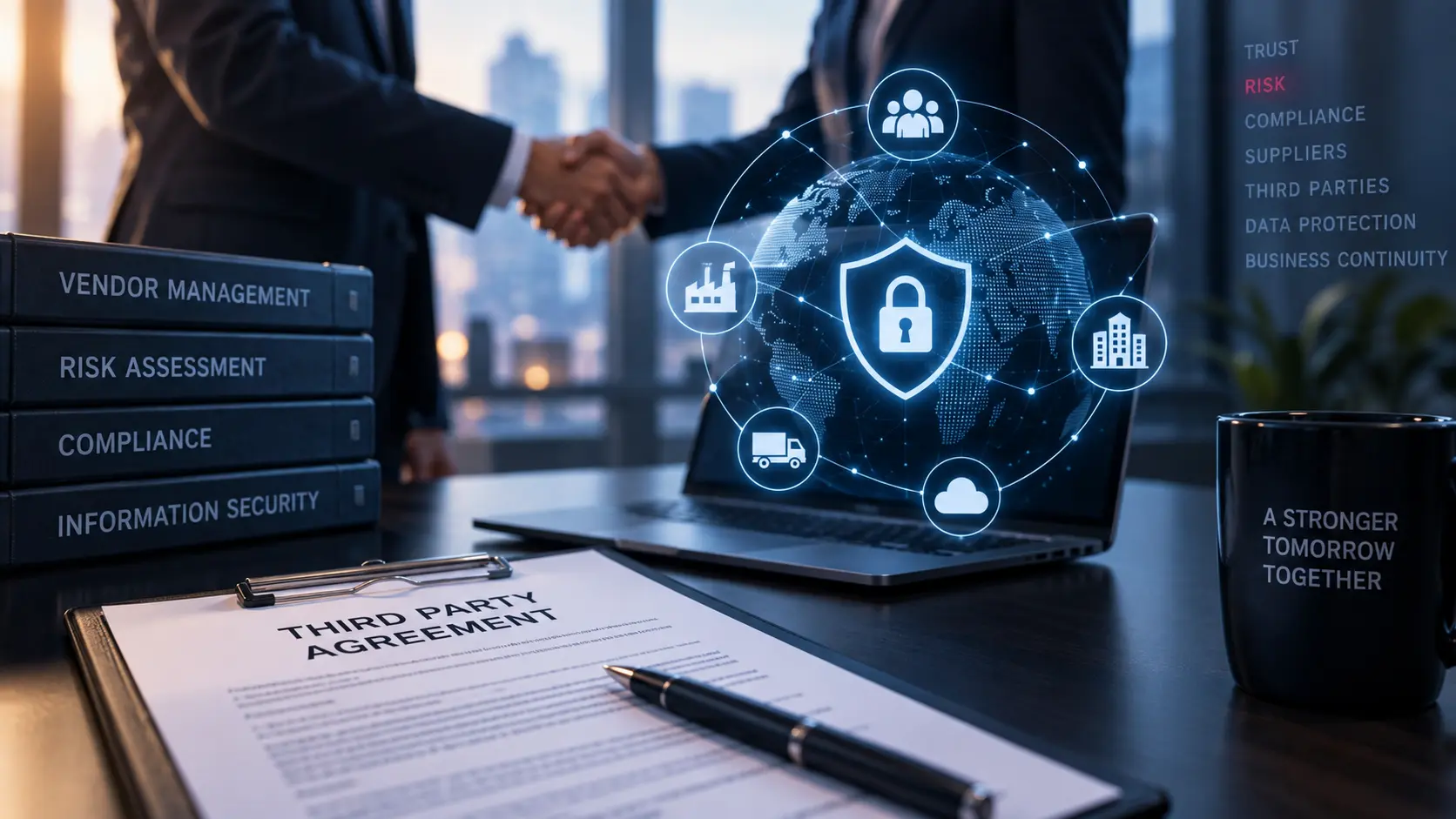
Cloud computing, Software-as-a-Service (SaaS), managed service providers, payroll processors, software development partners, Cyber Security vendors, consultants, logistics providers, payment gateways, data analytics platforms, and outsourcing firms have become integral parts of modern business operations.
This interconnected ecosystem has transformed the way organizations innovate, scale, and compete. However, it has also fundamentally changed the Cyber Security landscape.
An organization's security is no longer determined solely by its own infrastructure, policies, or employees. It is increasingly influenced by the security posture of every third party that stores, processes, transmits, or has access to organizational information.
This reality has given rise to one of today's most significant Cyber Security challenges: third-party risk. An organization may invest heavily in advanced Cyber Security technologies, Zero Trust architecture, Security Operations Centres (SOC), and ISO/IEC 27001 compliance. Yet if one of its suppliers operates with inadequate security controls, sensitive information may still be compromised.
Rather than attacking heavily protected organizations directly, attackers increasingly target suppliers, vendors, software providers, and managed service providers to gain indirect access to larger organizations.
This growing dependence on external partners is why ISO/IEC 27001:2022 Annex A.5.20 (Addressing Information Security within Supplier Agreements) and Annex A.5.21 (Managing Information Security in the ICT Supply Chain) require organizations to manage supplier security throughout the entire vendor lifecycle.
Supply chain security is no longer optional—it is fundamental to organizational resilience.
Modern enterprises rely on an extensive network of external service providers.
These commonly include:
Each supplier potentially handles valuable organizational information.
Every new vendor expands the organization's attack surface.
Third-party risk refers to the Cyber Security, privacy, operational, legal, financial, and compliance risks introduced through external business relationships.
These risks may arise when vendors have access to:
Organizations remain accountable for protecting their information—even when it resides within supplier environments.
If disposal fails, every previous security investment may be undermined.
Sophisticated cybercriminals increasingly recognize that suppliers often represent easier targets than large enterprises.
A successful attack against one service provider may provide access to:
Several globally significant Cyber Security incidents have demonstrated how compromised software vendors and service providers can become distribution channels for widespread attacks.
Supply chain security has therefore become a board-level concern.
Annex A.5.20 – Addressing Information Security within Supplier Agreements
Organizations should ensure that supplier contracts clearly define security expectations. Supplier agreements should address:
Security responsibilities should never remain ambiguous.
Annex A.5.21 – Managing Information Security in the ICT Supply Chain
Organizations should continuously monitor ICT suppliers throughout the relationship.
This includes:
Supplier security is a continuous governance activity—not a one-time procurement exercise.
Effective supplier security extends across every stage of the vendor relationship.
Security evaluation should begin before contracts are signed.
Organizations should assess:
Security should become part of procurement decisions.
Comprehensive vendor assessments may include:
Marketing brochures alone are not evidence of security maturity.
Objective validation is essential.
Contracts should clearly establish security obligations.
Typical clauses include:
Information Security Requirements
Vendors should maintain documented security controls aligned with recognized standards.
Data Protection
Contracts should define:
Incident Notification
Suppliers should commit to timely notification following security incidents affecting organizational information.
Rapid communication supports effective incident response.
Security Audits
Organizations should retain the contractual right to assess supplier security controls where appropriate.
\Access Management
Supplier access should be:
Least privilege applies equally to third parties.
Vendor security should not end after onboarding.
Organizations should regularly monitor:
Continuous oversight reduces emerging risks.
When supplier relationships end, organizations should ensure:
Vendor offboarding is an essential but often overlooked security process.
Cloud applications frequently process highly sensitive organizational information.
Organizations should evaluate SaaS providers based on:
Cloud convenience should never replace security governance.
Organizations should classify suppliers according to risk.
Typical assessment factors include:
Data Sensitivity
Does the supplier process confidential information?
System Access
Does the supplier have privileged access?
Business Criticality
Would disruption significantly impact operations?
Regulatory Impact
Does the supplier influence compliance obligations?
Geographic Location
Are international legal considerations involved?
Risk-based classification helps prioritize governance efforts.
Modern Governance, Risk, and Compliance (GRC) platforms increasingly automate supplier oversight.
Automation may include:
Automation improves consistency while reducing administrative effort.
Organizations frequently encounter:
These weaknesses frequently become organizational risks.
Organizations should establish supplier governance frameworks that include:
Security becomes a shared responsibility across the supply chain.
Organizations should:
Strong supplier governance reduces organizational exposure.
At Digital Task Force, we help organizations establish comprehensive supplier governance programs aligned with ISO/IEC 27001, privacy regulations, and global Cyber Security standards.
Our services include:
Our objective is to help organizations strengthen supply chain resilience without slowing business innovation.
The threat landscape continues to evolve rapidly, requiring organizations to rethink traditional supplier management. Several emerging trends are shaping the future of third-party risk governance:
Software Supply Chain Attacks
Attackers increasingly compromise software vendors, package repositories, and code-signing processes to distribute malicious updates. Organizations should monitor the integrity of software delivered by suppliers and verify digital signatures wherever possible.
Artificial Intelligence in Vendor Risk Management
AI-powered GRC platforms are being used to continuously evaluate vendor cyber posture, monitor external threat intelligence, detect compliance drift, and prioritize supplier risks based on real-time exposure.
Continuous Security Ratings
Instead of relying solely on annual assessments, many organizations now use external security rating services to monitor suppliers' internet-facing security posture, exposed assets, and publicly known vulnerabilities.
Zero Trust for Third Parties
Modern Zero Trust architectures require suppliers to authenticate continuously, enforce least-privilege access, and undergo ongoing verification rather than receiving persistent trusted access. These trends reinforce the principle that supplier governance must be dynamic, evidence-based, and continuously monitored.
Digital transformation has made organizations more interconnected than ever before.
Every cloud provider, software vendor, managed service provider, consultant, and outsourcing partner becomes an extension of the organization's information ecosystem.
Consequently, supplier security can no longer be viewed as a procurement responsibility alone—it is an essential component of enterprise Cyber Security and governance.
ISO/IEC 27001 Annex A.5.20 and A.5.21 emphasize that organizations must manage supplier security proactively through structured due diligence, contractual obligations, continuous monitoring, and secure offboarding.
Organizations that build mature vendor governance programs reduce cyber risks, strengthen regulatory compliance, improve operational resilience, and protect customer trust. Ultimately, the security of an organization is only as strong as the security of the partners it depends upon.
At Digital Task Force, we help organizations implement comprehensive media sanitization and hardware decommissioning programs aligned with ISO/IEC 27001, digital forensic principles, and regulatory requirements.
Contact us today to discuss your Cyber Security needs and discover practical solutions to better protect your digital assets.
Digital Task Force
dtf.pune@dtfservice.com | +919371971010
Stay informed. Stay vigilant. Stay secure.
© 2026 Digital Task Force (ISO-9001 : 2015 & ISO/IEC 27001 : 2022 Certified)