
Organizations invest significant resources in protecting sensitive information throughout its operational life. They deploy firewalls, encrypt databases, implement access controls, monitor networks, and conduct cybersecurity audits to prevent unauthorized access.
Yet one of the most overlooked stages of information security occurs after the data is no longer actively used.
When laptops are replaced, servers are retired, backup tapes are archived, mobile devices are upgraded, or storage drives reach the end of their operational lifecycle, many organizations assume that deleting files or formatting storage media is sufficient to eliminate sensitive information.
Deleting a file removes references within the operating system—it does not immediately erase the underlying data. Likewise, a quick disk format generally recreates file system structures while leaving much of the original information recoverable using readily available forensic recovery tools.
This misunderstanding has resulted in numerous incidents where confidential customer information, financial records, intellectual property, healthcare data, legal documents, and corporate communications were recovered from discarded devices long after they left organizational control.
For this reason, ISO/IEC 27001:2022 Annex A.7.14 (Secure Disposal or Re-use of Equipment) requires organizations to implement formal processes ensuring that information stored on equipment and media is permanently removed before disposal, reuse, or transfer.
Information security does not end when hardware reaches the end of its useful life. The final stage of the data lifecycle is often where organizations either preserve trust—or expose years of accumulated information to unnecessary risk.
Every storage device retains information.
This includes:
Many of these devices continue storing recoverable information even after users believe the data has been deleted.
Without secure sanitization, retired equipment becomes a valuable source of information for cybercriminals, competitors, and malicious insiders.
Information security extends beyond active operations.
A complete data lifecycle includes:
The final stage—secure disposal—is often the least understood despite being one of the most important.
If disposal fails, every previous security investment may be undermined.
Many users believe that moving files to the recycle bin permanently removes information.
In reality:
Digital forensic tools can often recover deleted documents, emails, images, databases, spreadsheets, and source code from inadequately sanitized media.
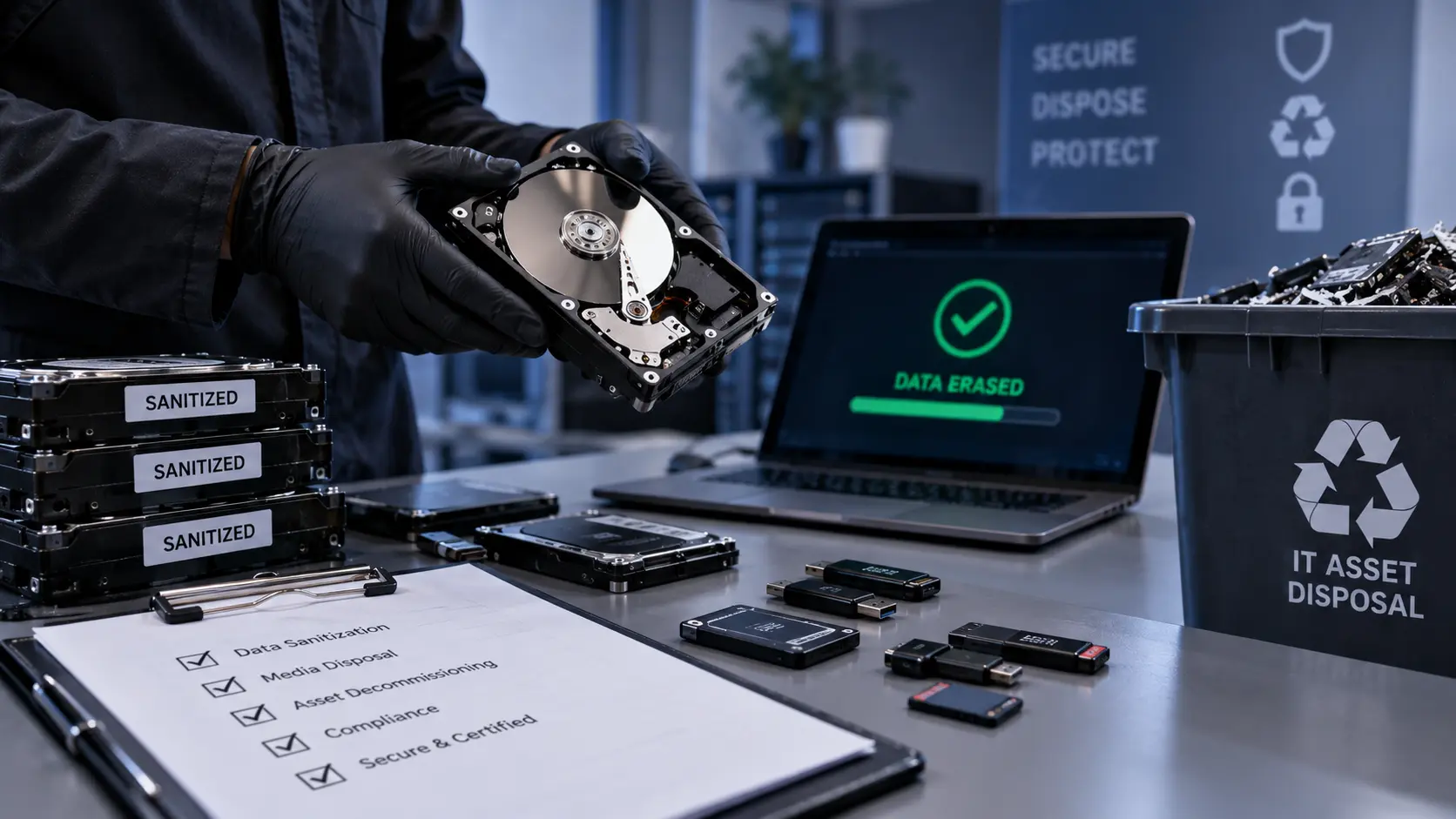
Proper sanitization requires much more than deletion.
Organizations frequently store retired equipment in:
Without proper governance, these environments may expose:
Unused equipment should be treated with the same level of security as active production systems.
ISO/IEC 27001 requires organizations to ensure that information-bearing equipment is securely sanitized before disposal or reuse.
The control emphasizes:
The objective is simple:
Information should never remain recoverable after equipment leaves organizational control.
Not every storage device requires the same disposal approach.
The selected method should reflect:
Risk-based decision-making is essential.
Logical Data Erasure
Logical sanitization uses software to overwrite storage sectors with new information.
This approach is appropriate when:
Modern sanitization solutions verify successful overwriting and generate detailed reports.
Cryptographic Erasure
When storage is protected using strong encryption, organizations may permanently destroy encryption keys.
Without valid encryption keys, encrypted data becomes computationally infeasible to recover.
Cryptographic erasure is increasingly used for:
It provides rapid and efficient sanitization when encryption has been implemented correctly.
Multi-Pass Overwriting
For certain storage technologies and organizational policies, multiple overwrite passes may be used to replace existing information with new data patterns.
Organizations should ensure that overwrite methods are appropriate for the media type and aligned with recognized sanitization guidance.
Degaussing
Magnetic storage media may require degaussing.
Industrial degaussers generate powerful magnetic fields that destroy recorded magnetic patterns.
Degaussed drives generally become permanently unusable.
This method is commonly applied to:
Physical Destruction
Highly sensitive information may require irreversible destruction of storage media.
Typical methods include:
Physical destruction prevents future recovery attempts.
Not all media behaves the same during sanitization.
Hard Disk Drives (HDDs)
Magnetic storage generally supports software overwriting and degaussing.
Solid-State Drives (SSDs)
Because SSDs use wear-levelling algorithms, traditional overwrite techniques may not reliably sanitize every physical memory cell.
Organizations should prefer:
Mobile Devices
Smartphones and tablets may contain:
Factory resets alone may not satisfy organizational sanitization requirements for sensitive environments.
Cloud Storage
Cloud environments require organizations to verify:
Cloud disposal involves governance rather than physical destruction.
Secure disposal extends beyond destruction itself.
Organizations should document every stage through a formal chain of custody.
Typical records include:
Chain of custody protects evidentiary integrity and accountability.
Organizations should obtain formal Certificates of Destruction (CoD) from certified disposal providers.
A robust certificate typically includes:
Certificates demonstrate compliance during audits and regulatory inspections.
Modern organizations increasingly rely on specialized IT Asset Disposition (ITAD) providers.
A reputable ITAD partner should demonstrate:
Selecting the right disposal partner is a critical governance decision.
Secure media disposal supports compliance with multiple frameworks and regulations, including:
Although requirements differ across jurisdictions, they consistently emphasize preventing unauthorized recovery of sensitive information.
Many organizations unintentionally expose themselves by:
These gaps create avoidable information security risks.
Organizations should:
Secure disposal should become a standard business process—not an ad hoc activity.
Information security is not complete when systems are decommissioned—it is complete only when the information stored within those systems can no longer be recovered.
Retired laptops, servers, storage devices, backup media, and mobile equipment often contain years of sensitive organizational information. If they are disposed of without proper sanitization, they become silent repositories of recoverable data that can undermine even the most mature cybersecurity programs.
By implementing structured media sanitization, maintaining documented chain of custody, selecting appropriate destruction techniques, and verifying disposal through certified evidence, organizations strengthen regulatory compliance, reduce cyber risks, and protect stakeholder trust.
At Digital Task Force, we help organizations implement comprehensive media sanitization and hardware decommissioning programs aligned with ISO/IEC 27001, digital forensic principles, and regulatory requirements.
Contact us today to discuss your Cyber Security needs and discover practical solutions to better protect your digital assets.
Digital Task Force
dtf.pune@dtfservice.com | +919371971010
Stay informed. Stay vigilant. Stay secure.
© 2026 Digital Task Force (ISO-9001 : 2015 & ISO/IEC 27001 : 2022 Certified)