
A Digital Task Force Information Security and Regulatory Governance Analysis
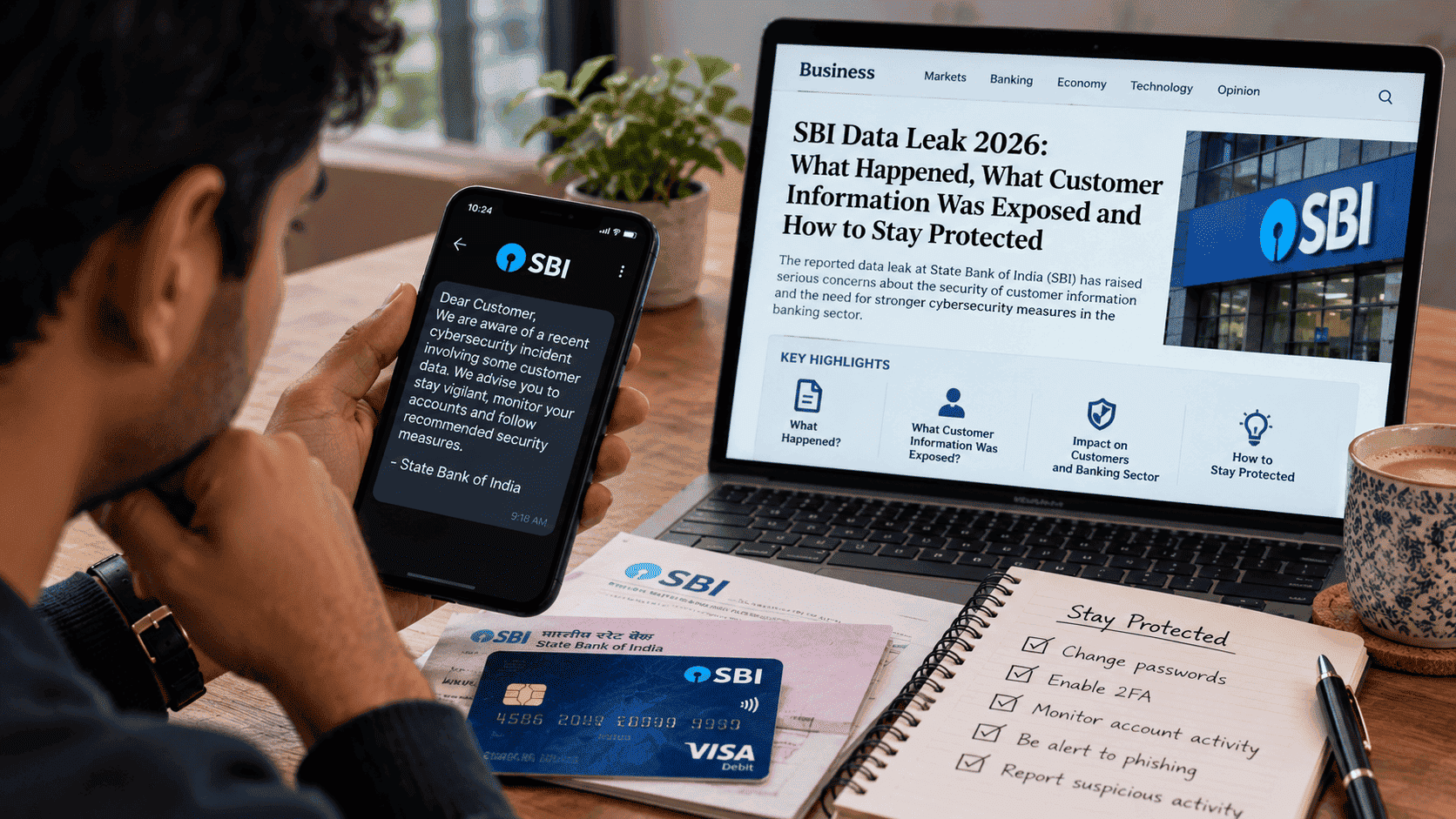
The reported October 2026 exposure of customer information associated with the State Bank of India has generated considerable discussion about banking cybersecurity and customer privacy.
Public disclosures indicated that preliminary examination of approximately 375,000 records found online identified 3,897 customer records containing personally identifiable information.
SBI activated its incident response procedures and commissioned an independent cybersecurity assessment.
The bank also reported no material disruption to its core business operations.
These developments raise a broader question for India's financial sector:
Are banking institutions sufficiently prepared to prevent, detect, investigate and contain the exposure of customer information across increasingly complex digital ecosystems?
The answer requires more than investment in firewalls, antivirus software or periodic compliance certifications.
Modern banking cybersecurity must address interconnected risks arising from cloud infrastructure, digital lending, API integrations, third-party service providers, artificial intelligence, privileged access, customer data processing and sophisticated social engineering.
It must also align technical security controls with applicable regulatory and statutory obligations.
This article examines the lessons financial institutions can draw from the reported SBI incident without assuming that any particular technical vulnerability caused the exposure.
The first article in this series examined the publicly reported incident and its implications for banking customers.
The central facts are straightforward.
SBI reported an incident involving the loss of certain data.
Its preliminary examination identified 3,897 records containing customer personal information within a larger collection of approximately 375,000 records.
The bank engaged an independent CERT-In-empanelled cybersecurity agency to investigate.
At the time of the initial disclosure, the precise origin and complete extent of the exposure had not been conclusively established.
These facts do not support attributing the incident to a specific software vulnerability, insider, supplier, cloud service or attack technique.
However, they do provide a useful foundation for examining the controls that banks should maintain to manage comparable risks.
A modern bank is not simply a collection of branches connected to a central database.
It is a distributed digital ecosystem involving:
Each component introduces operational dependencies and potential security exposures.
A vulnerability in one environment may create risk for information processed elsewhere.
This is why banking cybersecurity requires enterprise-wide asset visibility and continuous risk assessment.
Information Security Audits should determine whether controls are appropriately designed, implemented and operating effectively.
A mature banking audit program should evaluate several interconnected domains.
Auditors should assess:
The institution should maintain reliable inventories of:
Audit procedures should examine:
The assessment should evaluate:
Controls should address:
An audit should produce a risk-ranked remediation plan supported by objective evidence.
A completed audit report is not the same as demonstrated security effectiveness.
Vulnerability Assessment and Penetration Testing (VAPT) is a critical component of financial sector cybersecurity.
However, testing must extend beyond a single public-facing website.
Banking applications should be assessed for:
APIs connect banking applications with internal systems, payment platforms and external partners.
Security testing should examine:
Mobile assessments should consider:
Cloud assessments should examine:
Internal assessments should evaluate the risk of unauthorized movement between systems following an initial compromise.
Testing should be authorized, carefully scoped and designed to avoid disruption to critical banking services.
The purpose of VAPT is not merely to generate a list of vulnerabilities.
It is to establish whether weaknesses can expose sensitive information or undermine important business processes.
Banks depend on external providers for numerous business functions.
These may include:
Third-party access and data processing arrangements must be governed throughout the supplier lifecycle.
Banks should conduct risk-based due diligence and establish contractual security obligations.
Institutions should monitor supplier performance, access privileges, security incidents and material changes in service delivery.
Risk assessments should be refreshed according to the supplier's criticality and exposure.
Banks should verify that unnecessary access has been revoked and that information has been returned, retained or securely deleted according to applicable requirements.
These principles align with ISO/IEC 27001:2022 supplier security controls, including Annex A.5.19, A.5.20, A.5.21 and A.5.22.
Supplier involvement in the reported SBI incident has not been established publicly. Nevertheless, supplier governance remains an important industry-wide risk management priority.
Artificial intelligence is changing both defensive cybersecurity and criminal activity.
Attackers may use AI-enabled tools to improve the speed, personalization and scalability of social engineering.
AI can help criminals generate persuasive communications based on publicly available or exposed personal information.
Synthetic voice technologies may be used to imitate trusted individuals or authority figures.
Manipulated audio and video may support impersonation attempts, including fraudulent requests involving executives or customers.
Automation can accelerate the discovery and prioritization of exposed digital assets.
AI-generated messages can be adapted to different languages and customer profiles.
These capabilities do not eliminate the need for conventional security controls.
Instead, they increase the importance of identity verification, transaction monitoring, fraud analytics, customer education and incident response.
Banks should also govern their own use of AI, including data handling, model access, vendor dependencies, monitoring and human oversight.
India's Digital Personal Data Protection Act, 2023 establishes a framework governing the processing of digital personal data.
For banking institutions, relevant information may include:
Banks should assess their role as Data Fiduciaries and the responsibilities of processors acting on their behalf.
Organizations should ensure that individuals receive appropriate information about personal data processing as required by applicable provisions.
Banks must identify the appropriate legal basis for processing, including consent or other grounds permitted by the Act.
Not every banking activity necessarily requires consent; some processing may be supported by another lawful basis.
Institutions should limit collection and processing to information appropriate for legitimate purposes.
Personal data should not be retained indefinitely without an applicable purpose or legal justification.
Retention decisions must also account for banking, financial, tax, anti-money-laundering and other statutory requirements.
Banks should implement reasonable technical and organizational safeguards appropriate to the nature and risks of the processing.
The DPDP framework includes breach notification obligations, with operational requirements and commencement governed by the applicable notified provisions and rules.
Regulatory timing matters: As of 22 October 2026, key DPDP obligations are subject to phased commencement. The substantive breach notification provisions and related requirements scheduled for 13 May 2027 should not be presented as already fully enforceable.
Banks should use the transition period to establish systems, accountability and tested procedures rather than waiting until the effective date.
Banking institutions must assess cybersecurity obligations under applicable RBI directions and supervisory requirements.
Relevant areas may include:
The exact requirements depend on the category of regulated entity and the applicable RBI framework.
For example, the RBI's 2023 directions concerning IT governance, risk, controls and assurance practices establish requirements for covered regulated entities.
The RBI's 2023 directions concerning outsourcing of IT services address governance and risk management associated with covered outsourcing arrangements.
Banks should map each applicable requirement to a designated control owner, supporting evidence and review frequency.
Regulatory compliance should be demonstrable through operating controls, not merely policy declarations.
Effective incident response depends on reliable evidence.
Banks should maintain procedures for preserving:
Evidence preservation should support technical investigation, regulatory reporting and potential legal proceedings.
System clocks should use trusted time sources so that events can be correlated accurately.
Logs should be protected against unauthorized modification or deletion.
Evidence handling should be documented, including acquisition methods, custodians, timestamps and integrity verification.
Where appropriate, institutions should engage qualified independent specialists to establish incident scope and root cause.
Applicable CERT-In and RBI reporting requirements should be incorporated into incident response playbooks.
Organizations should not assume that one regulatory notification automatically satisfies all other reporting obligations.
Digital Task Force recommends a structured improvement program built around five operational pillars.
Pillar 1: Identify
Establish a reliable inventory of critical assets, sensitive information, business processes and third-party dependencies.
Pillar 2: Protect
Implement appropriate identity controls, encryption, secure configuration, network segmentation and data protection measures.
Pillar 3: Detect
Deploy centralized monitoring, threat intelligence, fraud analytics and effective alert investigation.
Pillar 4: Respond
Maintain tested incident response procedures, evidence preservation capabilities and regulatory communication workflows.
Pillar 5: Recover
Validate backup integrity, restoration procedures, business continuity arrangements and post-incident improvements.
These pillars should operate continuously rather than as isolated annual compliance exercises.
Priority activities:
Expected deliverables: Updated risk register, critical asset inventory, initial control-gap report and prioritized remediation plan.
Priority activities:
Expected deliverables: Technical assessment reports, validated vulnerability findings, remediation assignments and control improvement recommendations.
Priority activities:
Expected deliverables: Remediation verification report, incident response exercise findings, compliance roadmap and executive risk dashboard.
The sequence and timing should be adapted to the institution's size, complexity and regulatory obligations.
Banking cybersecurity should be measured through meaningful indicators.
Examples include:
Vulnerability Management: Percentage of critical vulnerabilities remediated within approved timelines.
Identity Governance: Percentage of privileged accounts reviewed and recertified.
Monitoring Coverage: Percentage of critical systems forwarding required security logs.
Incident Response: Mean time to detect, contain and investigate significant incidents.
Supplier Governance: Percentage of critical suppliers assessed according to the approved schedule.
Data Protection: Percentage of critical personal data processing activities documented and assigned to accountable owners.
Recovery Readiness: Percentage of critical restoration procedures successfully tested.
These metrics help management determine whether cybersecurity investments are producing measurable improvements.
Digital Task Force provides integrated cybersecurity, information security and regulatory advisory services.
Information Security Audits: Risk-based assessments covering governance, infrastructure, applications, identity management, security monitoring and information protection.
Vulnerability Assessment and Penetration Testing: Authorized assessments of web applications, APIs, mobile applications, networks and cloud environments.
DPDP Compliance Advisory: Data mapping, gap assessments, privacy governance, policy development, vendor reviews and implementation roadmaps.
ISO/IEC 27001:2022 Advisory: Information Security Management System development, risk assessment, control implementation and internal audit support.
Third-Party Risk Management: Supplier security assessments, contractual control reviews and ongoing governance.
Digital Forensics and Incident Response: Evidence preservation, incident investigation, root-cause analysis and technical reporting.
Governance, Risk and Compliance: Risk registers, compliance mapping, management reporting, corrective action tracking and audit readiness.
Security Awareness: Training programs addressing phishing, impersonation, financial fraud, data protection and incident reporting.
Our objective is to help organizations translate regulatory requirements and cybersecurity risks into measurable operational controls.
Before approving the next cybersecurity budget, senior management should seek clear answers to several questions:
These questions connect cybersecurity expenditure to business accountability.
The reported SBI data exposure highlights the growing importance of protecting customer information throughout its lifecycle.
For India's banking sector, the challenge is not limited to preventing unauthorized transactions.
Financial institutions must also protect the confidentiality and integrity of personal information, maintain reliable security monitoring, govern third-party access and respond effectively when incidents occur.
Artificial intelligence introduces new opportunities for both cybersecurity defense and criminal misuse.
India's evolving data protection framework adds further importance to governance, accountability and evidence-based compliance.
The appropriate response is not simply to purchase additional security products.
It is to build an integrated system of continuous assurance supported by Information Security Audits, VAPT, identity governance, data protection controls, forensic readiness and effective management oversight.
Cybersecurity maturity is demonstrated not by the absence of reported incidents, but by an organization's ability to identify risks, maintain effective controls, detect failures and respond with evidence and accountability.
Read the first article in this series for a detailed explanation of the reported incident, dark web exposure, customer risks, financial fraud scenarios and practical safety recommendations.
Read Part 1Digital Task Force combines cybersecurity engineering, digital forensic investigation, information security auditing and techno-legal expertise to help organizations strengthen security and regulatory readiness.
Our advisory approach focuses on practical implementation, objective assessment, defensible evidence and measurable improvement.
Digital Task Force — Secure Systems. Protect Data. Establish Digital Trust.
Can your organization demonstrate that sensitive customer information is continuously protected, monitored and governed across internal systems and third-party environments?
Digital Task Force supports financial institutions and enterprises with Information Security Audits, VAPT, ISO/IEC 27001 implementation, DPDP compliance assessments, incident response readiness and cybersecurity governance.
Contact Digital Task Force to discuss an enterprise cybersecurity risk assessment and compliance improvement roadmap.
Contact Digital Task Force© 2026 Digital Task Force (ISO-9001 : 2015 & ISO/IEC 27001 : 2022 Certified)