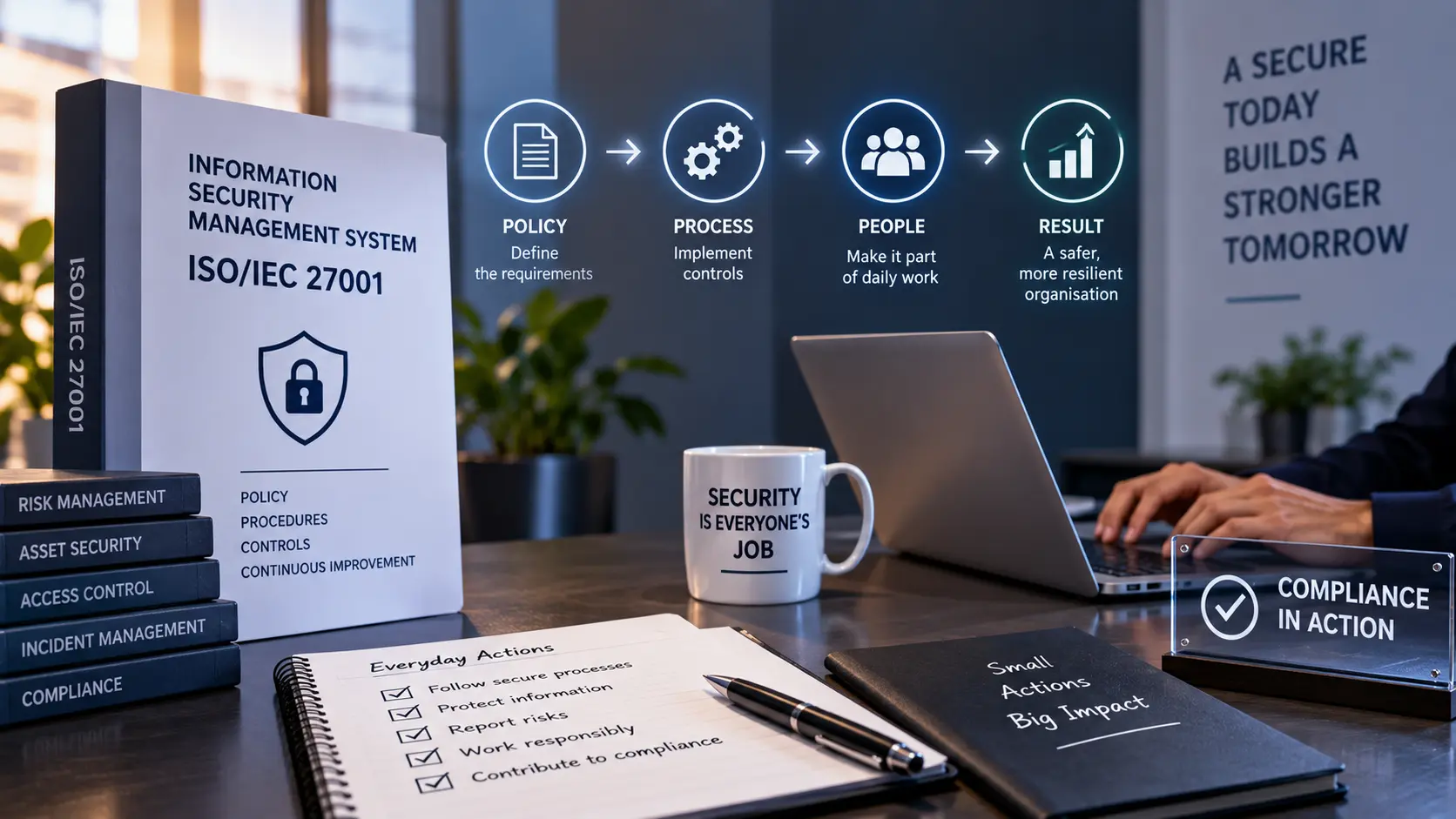

Every organization begins its information security journey by establishing policies, implementing technical controls, and educating employees about Cyber Security risks. These are essential building blocks, but by themselves they are not enough.
The true measure of a successful Information Security Management System (ISMS) is not the number of documented policies or completed training sessions—it is how consistently secure behaviours are demonstrated in everyday work.
The next step is transforming compliance from documentation into daily practice. Compliance becomes truly effective when it is embedded into organizational culture—when employees instinctively make secure decisions because security has become part of the way they work.
Compliance Is a Practice, Not a Project.
One of the most common misconceptions is that compliance has a clear finish line.
Many organizations believe compliance is achieved once:
As these changes occur, organizations must continually review, adapt, and improve their security practices.
This principle of continuous improvement lies at the heart of ISO/IEC 27001:2022.
Compliance is therefore not an event—it is an ongoing organizational discipline.
Daily behaviour transforms all of these into measurable security outcomes.
Employees rarely need to remember every sentence within an information security policy. Instead, organizations should encourage consistent behaviours that naturally align with policy objectives.
The goal is to move from:
Many of these devices continue storing recoverable information even after users believe the data has been deleted.
Without secure sanitization, retired equipment becomes a valuable source of information for cybercriminals, competitors, and malicious insiders.
Information security extends beyond active operations.
A complete data lifecycle includes:
to
This transition creates lasting organizational resilience.
The most successful compliance programs are built upon small actions performed consistently.
These habits become part of normal work rather than additional administrative tasks.
Examples include:
Verifying Information Classification
Before sharing documents, employees should routinely consider:
This simple habit prevents accidental information disclosure.
Locking Devices Automatically
Employees should instinctively lock:
Even brief periods of unattended access create unnecessary risks.
Reporting Suspicious Emails Immediately
Employees should never hesitate to report:
Prompt reporting often prevents widespread incidents.
Employees should request access through established processes rather than sharing credentials or using unauthorized workarounds.
Least privilege remains one of the strongest security principles.
Protecting Physical Information
Good habits include:
nformation security extends beyond digital systems.
Organizations sometimes focus heavily on annual compliance activities while overlooking everyday behaviours.
Examples include:
These activities remain important.
However, security incidents usually occur during ordinary working days—not during audits.
A single employee who:
may prevent an incident that annual compliance activities alone could never stop.
Consistent daily habits reduce risk continuously rather than periodically.
Employees observe leadership behaviour.
If managers:
employees naturally recognize that information security is genuinely valued.
Conversely, if leadership ignores established procedures, compliance quickly becomes perceived as optional.
Leadership commitment remains one of the strongest indicators of a mature information security culture.
Compliance should not remain isolated within IT or Information Security departments.
Managers play an important role by:
Managers help translate organizational policies into team behaviours.
Employees sometimes hesitate to:
Often, this hesitation stems from fear of criticism or disciplinary action.
A mature compliance culture encourages openness.
Employees should feel comfortable saying:
Early reporting almost always reduces organizational impact.
Silence creates greater risks than honest mistakes.
No organization completely eliminates cyber risks.
Information security is about continual improvement—not perfection.
Effective organizations monitor trends such as:
These measurements demonstrate organizational maturity over time.
ISO/IEC 27001 follows the internationally recognized Plan-Do-Check-Act (PDCA) model.
This means organizations continually:
Plan
Identify risks, objectives, and required controls.
Do
Implement policies, processes, awareness, and technical safeguards.
Check
Monitor performance through audits, reviews, and measurements.
Act
Improve controls, update policies, strengthen training, and address emerging risks. This cycle never ends because organizational security continuously evolves.
Compliance becomes sustainable when integrated into everyday business activities.
Examples include:
Compliance should support business operations rather than interrupt them.
Organizations often face challenges such as:
Viewing Compliance as Paperwork
Policies without practical implementation provide little value.
Treating Security as an IT Responsibility
Every employee contributes to information security.
Infrequent Awareness Activities
One annual training session cannot address constantly evolving cyber threats.
Lack of Leadership Engagement
Visible management commitment significantly influences employee behaviour.
Limited Communication
Employees require regular reminders, guidance, and opportunities to ask questions.
Organizations seeking lasting compliance should:
Culture develops through repetition rather than enforcement.
At Digital Task Force, we believe successful compliance extends far beyond certification. We help organizations embed governance, information security, and risk management into everyday business operations through integrated consulting and advisory services.
Our expertise includes:
Our objective is to help organizations develop practical, sustainable compliance programs that strengthen both security and business performance.
The future of compliance will increasingly emphasize:
Successful organizations will distinguish themselves not simply by complying with standards but by embedding secure behaviour into every aspect of their operations.
Compliance will increasingly become synonymous with organizational trust.
Policies, awareness, governance, and ISO/IEC 27001 are not separate initiatives competing for attention. Together, they form an integrated framework that enables organizations to protect information, reduce cyber risks, strengthen regulatory compliance, and build lasting trust.
The most effective compliance programs are those where secure behaviour becomes part of everyday work. Employees no longer think about whether they should follow a policy—they simply work securely because it has become a habit.
True compliance is achieved not through occasional audits or annual training sessions but through thousands of small, consistent decisions made every day by people who understand their role in protecting the organization.
When compliance becomes part of organizational culture, security becomes sustainable.
At Digital Task Force, we help organizations implement comprehensive media sanitization and hardware decommissioning programs aligned with ISO/IEC 27001, digital forensic principles, and regulatory requirements.
Contact us today to discuss your Cyber Security needs and discover practical solutions to better protect your digital assets.
Digital Task Force
dtf.pune@dtfservice.com | +919371971010
Stay informed. Stay vigilant. Stay secure.
© 2026 Digital Task Force (ISO-9001 : 2015 & ISO/IEC 27001 : 2022 Certified)