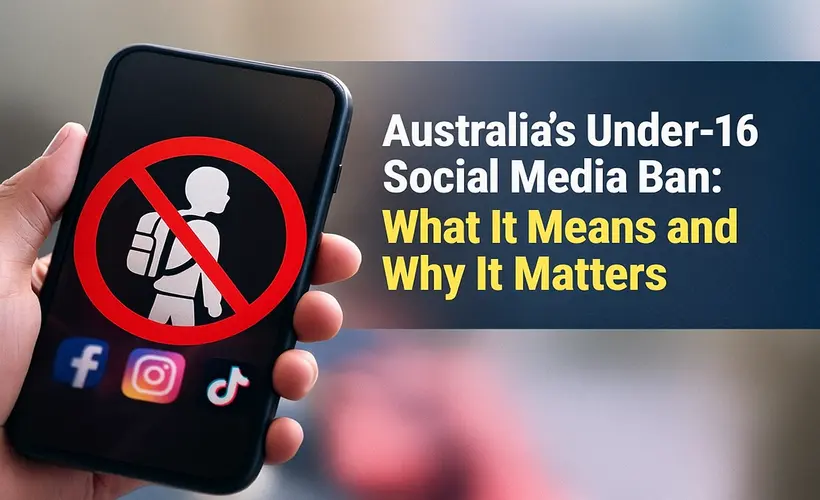
From 10 December 2025, a sweeping new regulation will redefine how young Australians interact with the digital world. Under the Online Safety Amendment (Social Media Minimum Age) Bill 2024, individuals under the age of 16 will no longer be permitted to create or maintain accounts on major social media platforms — including TikTok, Instagram, YouTube, Snapchat, X (formerly Twitter), Facebook, and others.
But this law doesn’t target children or their families. Instead, it squarely places responsibility on social media companies, who must take “reasonable steps” to prevent under-16 users from accessing their platforms. Failure to comply could lead to penalties of up to $50 million per platform.
This marks one of the most ambitious online safety reforms in Australia’s history — and it’s sparking a global conversation on how far governments should go to protect young people online.
On 28 November 2024, the Australian Government passed the Online Safety Amendment (Social Media Minimum Age) Bill 2024, setting a legal minimum age of 16 for account holders on designated platforms.
This means that if you’re under 16, the **platform—not you—**is responsible for ensuring compliance.
According to the Australian Government, the objective is to safeguard the mental health and wellbeing of young people in an increasingly digital environment.
Officials cite growing evidence that excessive or unsupervised social media exposure contributes to:
The goal is to delay exposure until teens are more emotionally resilient and digitally aware.However, many youth advocates — including UNICEF Australia — argue that a blanket ban oversimplifies the problem. For millions of teens, social media is not just entertainment; it’s a vital platform for learning, creativity, connection, and support.
The ban applies to most major social media networks:
Non-compliance could result in multi-million-dollar fines.
Excluded platforms — such as Messenger Kids, YouTube Kids, WhatsApp, Google Classroom, and Kids Helpline — are designed for educational or child-safe interaction and are not expected to be restricted.
Tech platforms will be required to deploy age assurance technology, which may include:
Users can expect new onboarding processes, age checks, and verification prompts by late 2025.
Young users won’t be punished.
The law is not directed at minors, but rather at platforms. There are:
Social networks must proactively detect, restrict, or remove under-16 accounts — but cannot impose punitive action on young users.
UNICEF Australia supports the conversation around child online safety, but warns against oversimplifying digital risks.
Their position:
“Removing access is not the same as ensuring safety. Young people deserve to be part of the conversation about the spaces they inhabit.”
UNICEF advocates for a collaborative approach:
Rather than exclusion, UNICEF envisions empowerment through education — equipping young people to navigate the internet responsibly.
At Digital Task Force, we recognise that online safety policy must balance protection, participation, and privacy.
While Australia’s under-16 ban underscores urgent concerns about mental health and exploitation, we believe the solution must go beyond restriction.
As global policymakers experiment with age-based restrictions, the future of online safety lies in education, empathy, and ethical technology design.
Australia’s under-16 social media ban is a landmark step in redefining child safety in the digital era.
Its impact will resonate far beyond Australia, sparking vital debate about how societies should balance online freedom with protection.
For now, one message stands out clearly:
“A safer digital world begins not by locking young people out — but by teaching them how to walk through it safely.”
© 2026 Digital Task Force (ISO-9001 : 2015 & ISO/IEC 27001 : 2022 Certified)

.jpg)
.jpg)
.jpg)